The Grid Is Growing Slower—Just When We Need It Fastest
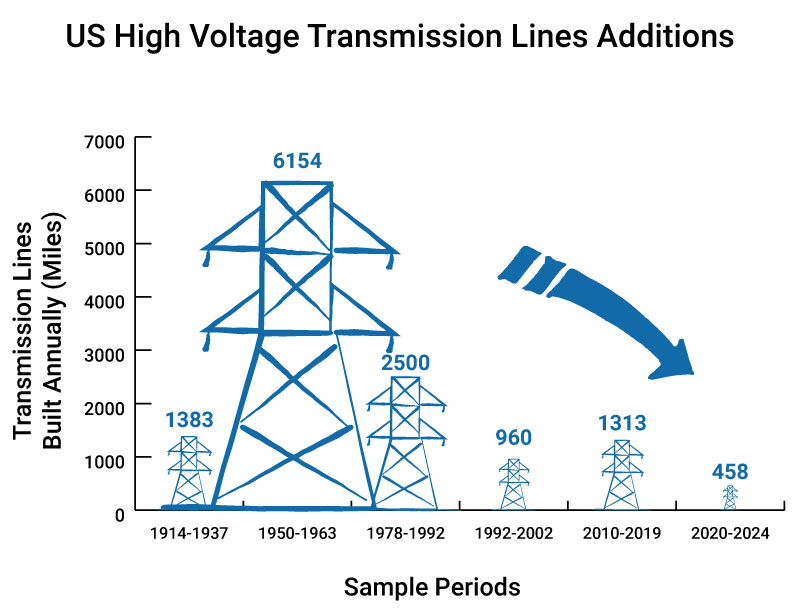
New transmission line construction in the United States has slowed to a crawl—at exactly the moment when electricity demand is accelerating. As the chart shows, we once routinely added thousands of miles of high-voltage lines per year. Today, additions are a fraction of historic levels, even as data centers, AI, electrification, and manufacturing resurgence strain the grid like never before.
Instead of building new long-distance transmission, much of today’s T&D investment is poured into maintenance, replacement, and small upgrades. The result is a grid that is aging in place while our power needs move forward at full speed.
The core problem isn’t engineering. We know how to design and build transmission. The roadblocks are permitting, local opposition, fragmented authorities, lawsuits, and policy paralysis. National policymakers talk about resilience and competitiveness, but they have been unable to override local permitting barriers—even when projects clearly serve national priorities.
The consequence is simple:
We are entering a high-demand, low-infrastructure era, and the mismatch will define the coming energy crisis.
If we cannot move electrons to where they are needed, innovation slows, costs rise, reliability erodes, and entire regions fall behind. The battle over transmission isn’t just technical—it is political, economic, and societal.
Want a deeper dive?
This post draws from themes in my forthcoming book, Power Plays: How the Battle for Electrons Will Define the 21st Century.
I’ve prepared a free Executive Summary Preview that covers:
-
why electricity demand is accelerating faster than expected
-
why the U.S. struggles to build infrastructure it desperately needs
-
how AI, data centers, EVs, and manufacturing collide on the grid
-
scenarios for where the crisis leads—and how we can still fix it
👉 Download the Executive Summary preview here
(No book purchase required — early access for subscribers.)