WHAT READERS ARE SAYING:

"Jacques Beaudry-Losiques' first book "Power Plays" is simply a much-needed masterpiece. He addresses a serious problem lurking in our society, which is the issue of our grid infrastructure and how surging demand for power will test its future preparedness to the core. Jacques does this thoughtfully and fearlessly, explaining the history and current state with considerable detail to provide the necessary context. Particularly impressive is the comprehensiveness of his approach, where he enlightens the reader from all perspectives (Federal policy and legislation, private sector competition, user requirements, global implications, and alternative energy sources as examples). He also manages to strike a perfect balance between technical detail and big-picture strategy, thereby appealing to a wide variety of audiences and reader backgrounds interested in this sector. Jacques does not shy away from raising the alarm and asking the tough questions, which have been lacking from most industry experts up until now.
The book's greatest value is that after highlighting the challenges with where we are, it then offers integrated solutions based on four distinct future scenarios. Since nobody knows where we'll be 5-10 years from now, this positing of different energy sector environments is both enlightening and fascinating. Jacques takes this a step further by applying game theory to these scenarios, which clarifies their implications to a degree not previously done by other authors covering this space.
Anyone who recognizes the importance of confronting our impending energy crisis, regardless of their role or level of expertise, will find "Power Plays" to be thought-provoking, highly relevant, and eminently readable."
Martin Lattman
Senior Instructor - UMBC Center for Leadership & Innovation

"While working with Jacques Beaudry-Losique on a distributed grid power solution engagement, he would occasionally talk about the upcoming crisis for the US power grid, but I didn’t fully understand the magnitude of the problem until reading "Power Plays: How the Battle for Electrons Wills Define the 21st Century". In the book Beaudry-Losique is able to articulate exactly what he meant by coming crisis, in a detailed yet easy to digest format. This book is a must read for anyone with an interest on how AI, cryptocurrency and reshoring are going to affect the US going forward and should be required reading for anyone involved in a high power usage industry like Big Tech, the energy sector as well as policy makers at every level. Readers will learn and understand why the US has largely lost the ability to build essential infrastructure at the necessary pace, resulting in a dangerous disconnect between ambitious strategic goals and physical power grid realities.
The most intriguing part of the book is "Power Play" game theory analysis, which maps out four potential futures ranging from a prosperous "High Economic Growth" scenario to a dystopian "Mad Max" outcome defined by rolling blackouts and industry migration. “Having heard much about NIMBY-ism using regulations to block housing developments, it was eye opening to have the book explain how the National Environmental Policy Act (NEPA) and other policies have evolved into "litigation-first" tools that stall critical transmission projects for decades. By contrasting the US "blocking culture" with China's rapid "building culture," Beaudry-Losique offers a pragmatic roadmap for success that emphasizes a "no regrets" strategy: embracing onsite energy, reforming nuclear permitting, and prioritizing grid-scale storage to ensure that clean, affordable electricity remains a pillar of American industrial might."
Derek Laan
International Business Consultant - Intralink Group, South Korea
"Energy is a looming crisis in America. For everyone interested in understanding America’s predicament in power generation, availability, and the grid, as well as navigating the future, Power Plays - How the Battle for Electrons Will Define the 21st Century is essential reading and will quickly become an irreplaceable reference. Written by an energy expert trained at Stanford, MIT, and the University of Montreal, with wide experience in both industry as well as the U.S. Department of Energy, the author presents his comprehensive knowledge in an easy-to-read style that provides an immediate understanding of this crisis.
The author compares the energy picture in China and in the US: China’s grasp of the growth required and America’s unawareness and inaction are stunning. America won the Cold War with the Soviet Union through capitalism, but the current competition with China is based on energy and the electrical power supply. (Think of the power needs for artificial intelligence.) We are losing, and changing this will take years. Examples include:
China’s electrical capacity grew more than tenfold since 2000, while America’s stagnated.
China builds twenty times the high voltage transmission lines each year than the US.
The book covers the regulatory obstacle course in America. The National Environmental Policy Act (NEPA) and its interlocking umbrella of regulatory schema with 18 other laws and regulatory legal schemes delay projects, (e.g., the Migratory Bird Treaty Act), while China’s governing model averts this.
Advantages held by the United States include tremendous supplies of coal and natural gas. But nuclear power generation remains the “silver bullet” of future world energy, as it is clean and dependable with ample fuel supplies.
Throughout, the author uses easy to understand ideas to illustrate issues: “Think about replacing your small, cheap, fully depreciated old clunker with a larger, more expensive new car. Although this forces you to pay more, the new car is necessary to accommodate your increasing requirements – and provide essential new functionality.”
The author presents “Gaming Out the Path Forward.” Immediate decisions and tactics are framed by the fact that it will still take at least a decade to build infrastructure projects.
He concludes, “…[S]uch is the US grid’s state of willful disrepair that many would argue that a strategic win for China is baked in, unless the US reacts with a Manhattan Project for the grid. However, fixing the grid is possible, but will require [immediate decisions for] massive infrastructure and engineering feats comparable to those achieved throughout our history.”
Brian Kane
Spacecraft System Engineer and Program Manager, retired
"Jacques Beaudry-Losique’s Power Plays provides an insightful look at the practical challenges of the modern electrical grid. Rather than focusing solely on the environmental goals of the energy transition, he addresses the physical and regulatory limitations that are making it harder to keep the lights on. The book argues that reliable electricity has become the primary factor in economic competition. He illustrates this through a "Power Gap", a growing disconnect where our demand for power driven by things like AI data centers and new industrial plants is moving much faster than our ability to build the infrastructure to support it.
A clear example of this is his discussion of Loudoun County, Virginia. As a global hub for data centers, the area is already hitting the limits of what the local grid can provide. It serves as a warning for other regions. Even with high investment and demand, the physical reality of the grid can stall economic growth. Beaudry-Losique uses his years of industry experience to explain why we are stuck in "permitting purgatory" where litigation and outdated regulations like NEPA holds up projects for a decade or more.
The book is structured to be useful for a wide range of professionals, students, and professors who will find value in Beaudry-Losique’s easy to digest technical and emerging market explanations. Town managers and policymakers will also get a realistic view of why local energy resilience is now a requirement for attracting new business. It’s a straightforward, well-paced read that moves past the typical energy debate to focus on the technical and political hurdles we must clear to maintain a functional economy. "
John Morris
International Product Development & Supply Chain Executive
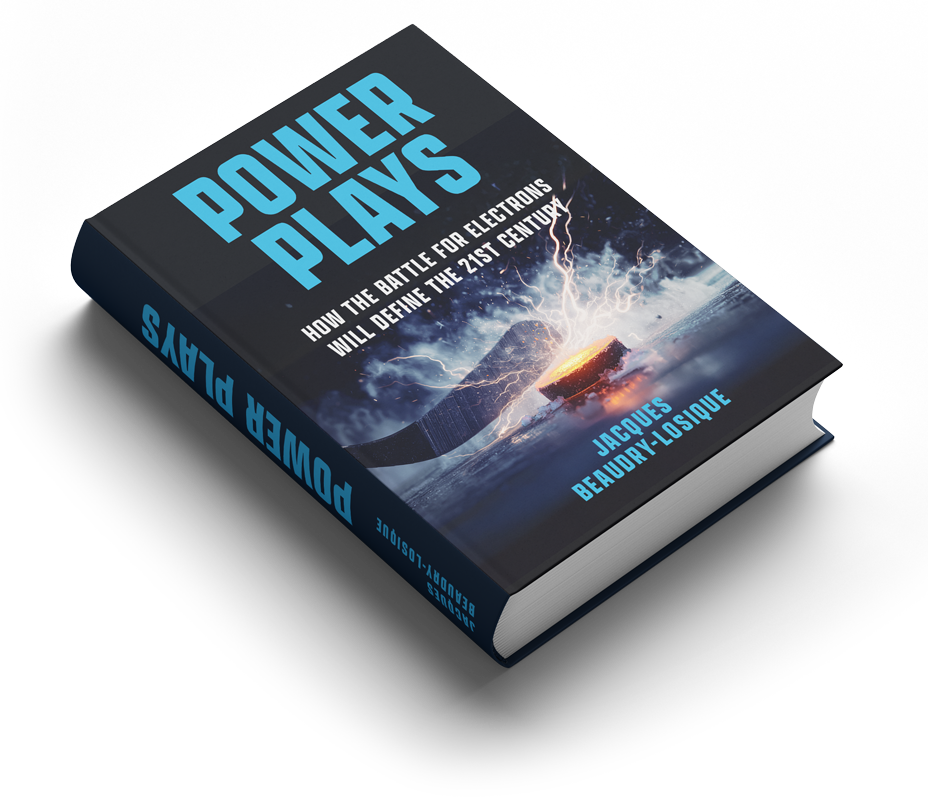
"POWER PLAYS: How the Battle for Electrons Will Define the 21st Century offers a piercing insider’s perspective on an impending national crisis: the likelihood of the United States running out of energy in a rapidly transforming world. It takes readers through the history of power grids, policy, alternative energy solutions, the need for power, and solutions that would help the US ensure that the lights don’t go out. Although they may be transitional, changes brought by industry, artificial intelligence, and cryptocurrency show how new demands have forged new needs and contribute to discussions about energy, economic possibilities, and the country’s ability to sustain leadership internationally. These all affect the struggle to maintain an international edge with the limits the country faces.
The writing style here is fast-paced, authoritative, and urgent, as author Jacques Beaudry-Losique shows us that the crisis is not only inevitable but already underway: “The 117 planned Loudoun County data centres will need an extra 9.4 GW of power by 2029. But the whole county only used 3.4 GW for all users in 2023.” By raising the alarm and backing it with hard math, the book further explores alternate renewable energy sources such as wind, solar, nuclear, and gas. Beaudry-Losique also digs into the limits placed on policy and government decisions because of the environmental movement and how this limits freedom to find solutions.
Each section is thoughtful, well laid out, and easy to understand, as POWER PLAYS includes diagrams, bullet points, and graphs to enhance the reader’s ability to understand. However, because the book is very dense, it’s best read in sections. Absorbing the data takes time, though it does follow logically from section to section.
Shaped by both conviction and clarity, the book is erudite and uses metaphor effectively to give systems that would otherwise be abstract a visceral presence. The writing is centered firmly on structure and strategy, yet still resonates with the reader—making it both an informative and interesting book that makes us reflect carefully on how policy, choice, and changes to the world impact everyday life. Clarifying the problem and making the need for change impossible to ignore, POWER PLAYS will appeal most to readers who want to understand both what is happening in the energy system and what stands in the way of fixing it.
Author Jacques Beaudry-Losique’s POWER PLAYS: How the Battle for Electrons Will Define the 21st Century delivers a rigorous, accessible, and insightful analysis of the national energy crisis that combines authoritative research with an engaging narrative."
For IndieReader
"A comprehensive look at the current state of the U.S. energy structure and its possible future.
Beaudry Losique, who has worked in the North American energy field for years, describes himself as an energy geek who lives and breathes electrons, molecules, and all things related to energy technology. He opens his book with a dire warning: The next energy crisis is already here. The U.S., he contends, bogged down by obstructionist legislation, byzantine regulation laws, and a cumbersome industry structure, is facing an oncoming disaster comparable to those experienced by the many countries dealing with chronic energy shortages and rolling blackouts on a regular basis. The nation’s demand for electricity is growing at a far greater pace than its aging and patchwork energy grid can handle, per the author; to fill in this picture, Beaudry-Losique provides a quick but detailed rundown of the energy demands now growing in the modern world and the industries and systems currently in place to fulfill those demands. Using copious amounts of data and plenty of charts and graphs, the author examines the largely ramshackle structure of U.S. energy systems and makes proposals for various improvements that take into account everything from climate change to the exponential energy demands created by AI data-processing centers, all while extrapolating possible future scenarios. The tone is always direct, the claims are consistently backed up by data, and the author’s wealth of experience is evident on every page. Beaudry-Losique is not an idealist; he knows perfectly well, for instance, that nations and organizations faced with an “unrealistic crusade to abolish a strategic industry within a few years” in favor of cleaner power sources are more likely to entrench and resist. This prognosis will frustrate readers who very clearly hear the clock ticking, but skeptics and believers alike should read this book; the author’s argument is too compelling to ignore.
A granular and powerful analysis of the energy crisis coming for us all."
Kirkus Reviews
STAY UPDATED
GET THE NEWSLETTER
Sign up to be the first to know when my book is available.
Thank you for subscribing!
Have a great day!