The Power Gap: How China Built the Grid America Didn’t
China didn’t out-innovate the United States— but it did out-built it.
While the U.S. continued to prize the soft arts of discovery, finance, and digital content, China focused on hard core engineering, manufacturing, and infrastructure—steel in the ground. The result is visible across nearly every 21st century strategic sector first pioneered in America: critical minerals, solar and wind components, electric vehicles, batteries, and 5G. Today, self-generative AI is the newest battlefield—and for this battle, electricity abundance may determine the winner.
Unlike the U.S. and much of the West, China aligned its energy system with its industrial and technology ambitions:
- Advanced transmission network — check
- Massive renewable deployment — check
- Nuclear power — check
- Advanced fossil generation — check
- Domestic supply chains — check
- Skilled workforce to design, construct, and operate large systems — check
The outcome is striking. China now meets its own immense infrastructure and manufacturing needs and supplies much of the world’s demand for rare earths, batteries, solar panels, and other critical technologies.
For decades, the U.S. chose a different path—one shaped by skepticism toward industrial policy, blind faith in frictionless globalization, and a financial system rewarded for outsourcing physical capacity. Economists provided the sugar-coated theory. Wall Street cheered the plump margins. Industrial capacity closed or moved offshore, and China became the undisputed global industrial powerhouse.
The chart below captures one of the results: a widening electricity generation gap that mirrors the broader shift in industrial power.
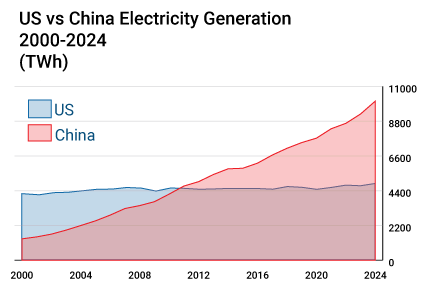
US Energy Information Administration, “China,” (n.d.), https://www.eia.gov/international/data/country/chn, US data: US Energy Information Administration, “United States,” (n.d.), https://www.eia.gov/international/overview/country/USA.
America’s new challenge is to restructure its institutions to mobilize capital, labor, and political will fast enough to compete in an energy-intensive world.
For a deeper look at how electricity, infrastructure, and geopolitics intersect—and what choices lie ahead—download the Executive Summary of Power Plays, available now for a limited time.